
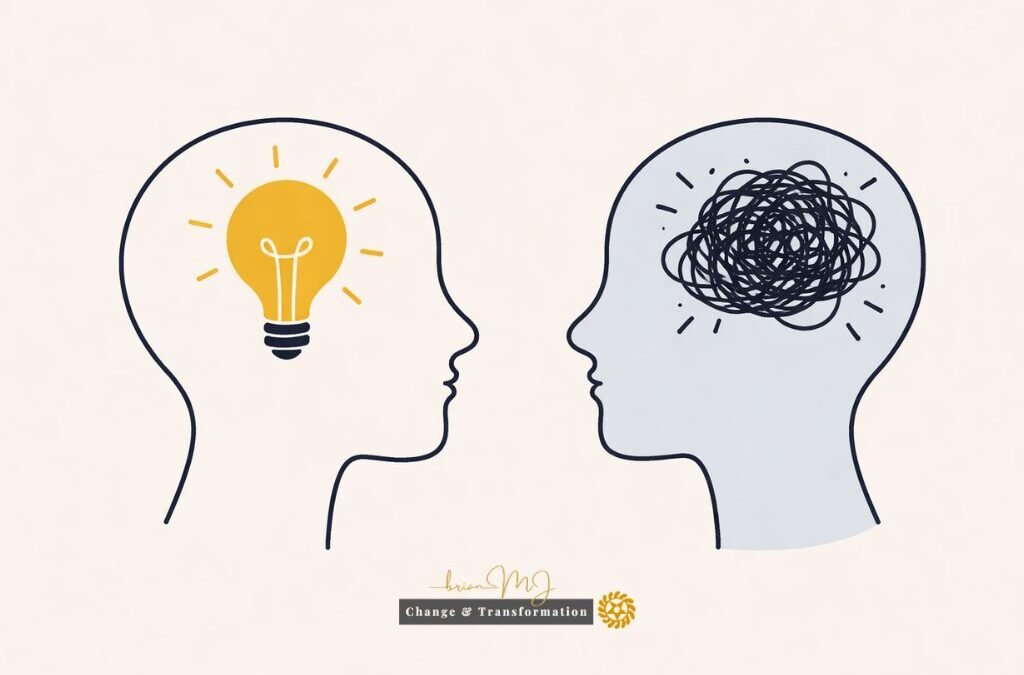
One of the most confusing experiences in a difficult relationship is knowing something is wrong, yet still feeling unable to leave.
You may recognise the hurt, the inconsistency, or the emotional instability, and still find yourself defending the relationship, minimising what happened, or hoping it will change.
This tension is not a sign of weakness.
It is often the result of a psychological process known as Cognitive Dissonance.
Understanding this process can help explain why toxic relationships can feel so difficult to walk away from.
Why This Happens
If you feel torn between knowing a relationship hurts you and still wanting it to work, you may be experiencing Cognitive Dissonance.
This psychological process occurs when two conflicting beliefs exist at the same time. In relationships, it often appears as:
- Knowing the relationship is painful
- Remembering moments of genuine connection
- Struggling to reconcile the two experiences
The mind naturally tries to resolve this contradiction. Often, it does so by protecting the relationship rather than challenging it.
Understanding this process can help explain why clarity sometimes takes time to emerge.
The Brain Struggles With Conflicting Realities
Cognitive dissonance occurs when two beliefs or experiences contradict each other.
In a relationship, this often looks like holding both of these ideas at the same time:
“This person loves me.”
“This person hurts me.”
Both feel real. Both are supported by experience.
The mind does not tolerate this contradiction easily.
So it begins trying to resolve the conflict.
Unfortunately, the brain often resolves it by protecting the relationship, not by challenging it.
How the Mind Resolves the Conflict
To reduce the discomfort of cognitive dissonance, the brain quietly starts adjusting the narrative.
You might find yourself thinking:
“They didn’t mean it like that.”
“They’re just stressed.”
“All relationships are difficult sometimes.”
“Maybe I’m overreacting.”
These explanations ease the internal tension.
But they also slowly shift responsibility away from the behaviour and onto interpretation.
Over time, the relationship can start to feel less clearly harmful, even when the patterns continue.
When Kindness and Harm Exist Together
Another reason cognitive dissonance becomes so powerful in relationships is that harmful dynamics are rarely constant.
This often happens in relationships shaped by intermittent reinforcement.
Moments of warmth, connection, or apology can appear between periods of distance, criticism, or emotional withdrawal.
Those positive moments matter.
They feel real because they are real.
When kindness and harm exist together, the brain naturally focuses on the moments that confirm the belief that the relationship is loving.
This makes the painful moments harder to integrate into a clear understanding of the situation.
Why Leaving Feels So Confusing
When cognitive dissonance is active, clarity becomes unstable.
One day the relationship may feel deeply meaningful.
Another day it may feel exhausting or painful.
Both perceptions can exist simultaneously.
This emotional instability can lead to thoughts such as:
“Maybe I’m giving up too quickly.”
“Maybe every relationship is like this.”
“Maybe things will improve if I just try harder.”
The mind is not intentionally misleading you.
It is simply trying to reduce psychological conflict.
The Moment Clarity Begins
Clarity begins when both sides of the experience are allowed to exist without being forced into a single explanation.
The relationship may include moments of care.
And it may also include patterns that create distress or instability.
Recognising both realities does not mean dismissing the good.
It means seeing the full pattern rather than isolated moments.
Over time, this broader view allows the nervous system to settle and the mind to regain coherence.
When the contradiction no longer needs to be explained away, the relationship can be evaluated more clearly.
Understanding Creates Space
Leaving a difficult relationship is rarely a single decision.
It is often a gradual process of understanding what has been happening and why it has felt so difficult to interpret.
Psychological mechanisms like Cognitive Dissonance can make confusing situations feel even more tangled.
But once the mechanism becomes visible, the experience often begins to make more sense.
And with understanding, clarity tends to follow.
A Quiet Realisation
Sometimes the hardest part of understanding a difficult relationship is recognising that the confusion itself had a cause.
When two opposing experiences exist at the same time (care and harm, closeness and distance), the mind works hard to make sense of both. That effort can blur clarity for a long time.
What once felt like uncertainty or self-doubt may simply have been the natural tension of Cognitive Dissonance at work.
When that tension begins to ease, people often find that their understanding of the relationship becomes calmer and more stable.
And from that place, decisions tend to become clearer.
Recent Comments