
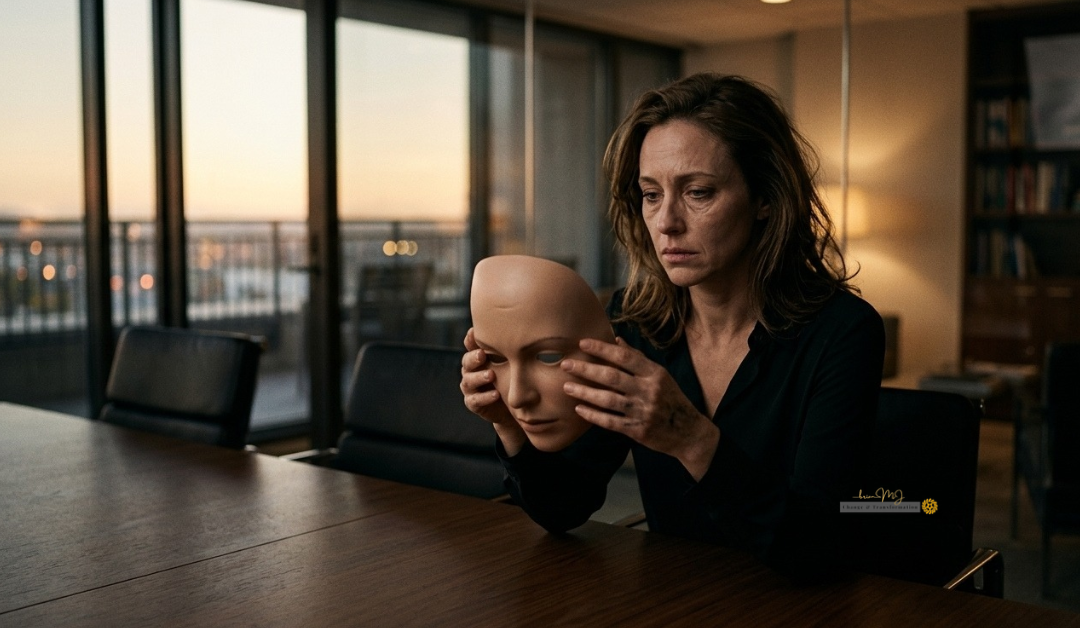
There’s a particular kind of exhaustion that comes from looking fine. Not feeling fine, looking it.
That’s the performance of peace, and it takes real, constant effort to keep it running. It takes real, constant effort, and most people who are good at it have been practising for years without ever naming what they were doing.
Last week’s reels pointed at two versions of the same thing.
One: you’re not healing, you’re just getting better at hiding it. The other: most leaders don’t want honesty, they want agreement that sounds like honesty.
Different settings, same mechanism, managing how something looks rather than changing what it actually is.
The flaw in looking better
There’s a real difference between a trigger that’s lost its power and a trigger you’ve simply gotten quieter about.
One means the reaction is genuinely gone. The other means the reaction still happens, every time, you’ve just become skilled enough at hiding it that nobody else has to see.
That skill isn’t nothing. Staying composed under something that still stings takes real effort, sustained, and mostly invisible. But composure isn’t the same as resolution, it’s closer to a cost being paid quietly, over and over, so that other people don’t have to witness the bill.
Over time, this can start to feel like an identity rather than a habit.
Being the easygoing one, the healed one, the person who doesn’t react, becomes something to be proud of, which makes it even harder to put down.
But real peace was never about the absence of reaction. It’s the freedom to actually have one, out loud, without expecting it to cost you the relationship, or the room.
The workplace version
The same pattern plays out at scale in organisations.
Leaders will say, often sincerely, that they want honest feedback. Fewer actually want to hear something that contradicts a decision they’ve already made.
What tends to get rewarded instead is a specific kind of compliance, confident, articulate, dressed up as strategic insight. But it isn’t insight. It’s confirmation of what leadership already wanted to hear, delivered with enough polish to feel like independent thought.
Teams learn this quickly, and once they have, they stop informing their leaders and start managing them instead, filtering, softening, choosing which truths are worth the cost of saying out loud.
This rarely announces itself. It shows up as a slow drift: real engagement, then careful silence, then quiet disengagement nobody flagged in a meeting.
A quiet team isn’t necessarily a loyal one. More often, it’s a team that did the maths on honesty and decided it wasn’t worth the price.
The performance of peace: why the mask gets chosen
Both patterns persist for the same reason: the mask is cheaper today than the truth would be. Performing composure keeps a relationship calm in the moment, even as it quietly erodes the closeness underneath.
Performing agreement keeps a meeting comfortable, even as it quietly stores up the exact blind spots that cause real damage later.
In both cases, the short-term trade looks sensible. Avoid the friction now. Avoid the discomfort.
The cost only becomes visible once it’s already compounded, in a relationship that’s gone hollow, or a decision that fails for a reason everyone secretly saw coming.
What shifting this actually looks like
For a person, the useful question changes from “how do I make this look fine” to “what is actually happening right now.” That’s a small shift, but it’s the difference between managing an appearance and being honest about a state.
For a leader, the equivalent question isn’t “does everyone agree.” It’s “what is this room avoiding saying right now.” Asking it won’t guarantee an honest answer, but it’s the only question that leaves room for one.
Peace and loyalty don’t survive in places where friction isn’t allowed. The goal was never a life, or a team, that never makes noise. It’s one where the truth doesn’t cost you your safety to say.
Brian Jones writes on change, transformation, and the psychology of boundaries at brianmj.com.
Related reading
Recent Comments